3-Day Dumbbell Starter Plan: Free Weight Bundle Guide

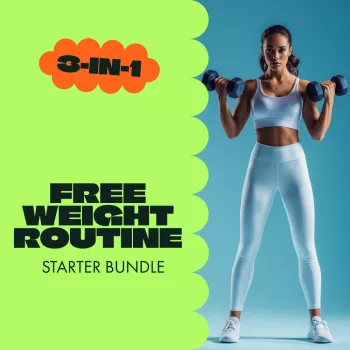
Free Weight Routine Starter Bundle: A Simple 3-Part Digital Plan to Build Strength
Starting strength training with dumbbells can feel straightforward—until it’s time to choose workouts, set reps, and progress safely. The Free Weight Routine Starter Bundle is a 3-in-1 digital download set designed to remove the guesswork with a simple, repeatable structure you can run at home or in the gym. Instead of jumping between random workouts, you get a routine framework you can track, repeat, and steadily improve.
This approach aligns with widely used resistance-training principles: practice the same key movement patterns consistently, apply gradual progression, and prioritize form and recovery. For general activity guidelines that complement strength training, see the CDC’s physical activity recommendations for adults.
Who this starter bundle fits best
- Beginners who want a clear weekly structure instead of random workouts
- Returning lifters rebuilding consistency after time off
- Home exercisers training with dumbbells and a bench (optional)
- Busy schedules that benefit from a repeatable plan and simple progression rules
If your biggest barrier is decision fatigue—figuring out what to do each day—this style of plan can be the difference between “sometimes training” and building a real routine.
What the 3-in-1 digital set is meant to solve
- Provides a ready-to-follow routine framework so training days don’t require planning from scratch
- Encourages balanced training across major movement patterns (push, pull, squat/hinge, core)
- Helps prevent early plateaus by organizing progression and repetition targets
- Supports safer technique practice through repeatable exercise selection rather than constant changes
Consistency is a skill. Repeating key lifts (with small, planned changes) gives your body time to learn technique, build coordination, and adapt without constantly “resetting” to brand-new movements.
How to set up the routine in under 30 minutes
- Choose training frequency: 3 days/week is a practical default for most beginners
- Pick a consistent schedule (e.g., Mon/Wed/Fri) to improve adherence
- Select available equipment: dumbbells, adjustable bench if possible, resistance band as optional accessory
- Decide on starting weights using a conservative effort level: stop with 2–3 reps in reserve on most sets
- Create a simple tracking method: notes app or spreadsheet for weights, reps, and rest times
Quick-start setup checklist
| Step | Decision | Simple default |
|---|---|---|
| Training days | 2–5 days/week | 3 days/week |
| Session length | 20–60 minutes | 35–45 minutes |
| Effort target | To failure vs. controlled | 2–3 reps in reserve |
| Progression | Add weight, reps, or sets | Add reps first, then weight |
| Tracking | Paper/app/spreadsheet | Notes app + weekly recap |
A starter-week structure (example you can mirror)
- Day 1: Lower body + push + core (focus on controlled technique and consistent tempo)
- Day 2: Pull + hinge + core (prioritize back engagement and hip mechanics)
- Day 3: Full body repetition (slightly lighter loads, cleaner reps, longer range of motion)
- Keep warm-ups simple: 5 minutes of light cardio or mobility, then 1–2 lighter sets before work sets
- Rest times: 60–120 seconds for most movements; extend for heavier sets to keep form strict
What matters most isn’t the “perfect” weekly split—it’s choosing a structure that you can repeat. When the days are predictable, your training log becomes clearer, and progress becomes easier to spot.
Progression rules that keep momentum without burnout
- Use a rep range (for example 8–12): when all sets hit the top number with solid form, increase weight next session
- If form breaks, reduce weight slightly and rebuild reps rather than forcing heavier loads
- Deload when needed: if performance drops for 2–3 sessions, reduce volume or load for one week
- Track small wins: an added rep per set across a week is meaningful progress for beginners
- Prioritize consistency over complexity; the most effective plan is the one repeated week after week
Progress doesn’t need to be dramatic to be real. A steady, repeatable progression model is widely supported in strength training research and coaching practice, including the ACSM position stand on progression models in resistance training.
Technique and safety essentials for free weights
How to know it’s working (signals to watch over 4 weeks)
Get the Free Weight Routine Starter Bundle (digital download)
If you want a simple plan you can run on repeat, the Free Weight Routine Starter Bundle – 3-in-1 Digital Download Set for Strength Training is built to keep training decisions minimal and execution consistent. Pair it with a basic training log so you can track weights, reps, and rest times week to week.
To support recovery and day-to-day consistency, consider adding a calming routine on rest days or after lifting. The Simple AI-Powered Relaxation You Can Feel | AI Breathing Exercises for Relaxation | Digital Guide for Daily Calm and Stress Relief can be a practical add-on for downshifting after workouts.
If you’re refreshing your training basics for gym or home sessions, the Jacquemus Torneo Mélange Sport Shorts for Men are an optional gear upgrade for comfortable movement during lower-body days and full-body sessions.
FAQ
Is this routine suitable for complete beginners?
Yes. It’s designed to start with manageable dumbbell loads, use rep ranges, and reinforce consistent exercise practice so form improves quickly. If you have injuries or health conditions, medical clearance may be appropriate before beginning.
How many days per week should a beginner lift with dumbbells?
Most beginners do well with 2–4 days per week, depending on recovery and schedule. Three days per week is a common starting point; add days only after you can hit your current schedule consistently.
What equipment is needed to follow a free weight starter routine?
Dumbbells are the primary tool. An adjustable bench is helpful but optional, and resistance bands or a mat can be nice accessories without being required—most routines can be adapted to the equipment you already have.







Leave a comment